
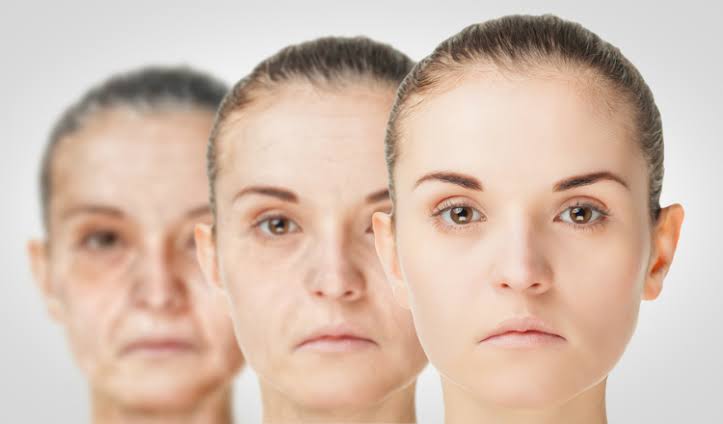
👉 Grief can cause Premature Aging and health problem?
The Bible states :
👉 In Psalms 6:7 ” Mine eye is consumed because of grief; it waxeth old because of all mine enemies.
The mind plays a significant role in whether we are aging faster or slower, and we can use the mind to help us accelerate or decelerate the process. Happier people are quite simply younger looking people. The more you hold hope, optimism, and joy at the top of your list of priorities, the younger your face will appear. Moreover, happier people live longer often with fewer health problems like heart disease, high blood pressure, and even aching joints and bones.
Perpetual anger and distress can form permanently on the face in the form of fine lines and deep wrinkles. When the face expresses chronic sad or angry emotions, the constant scowling can turn into wrinkles formed by muscle memory.
A happier face is devoid of wrinkled eyebrows and scowl marks because the muscles have spent more time in a relaxed state. This doesn’t mean that one bad day will give you a face full of wrinkles, but how your face carries your expression more than 50% of the time can determine how prematurely you form wrinkles, where, and how deeply.
And now, new research may shed a little more light on part of the reason why. A study recently published in the journal Ageing and Immunity found that among the elderly who suffer grief , in particular, the recent loss of a loved one may leave a person more vulnerable to infectious diseases.
Previous research has found that following the death of a spouse, people were likely to report more self-medication and worse overall health. Grief has also been found to aggravate physical pain, increase blood pressure and blood clots, and exacerbate appetite loss—possibly because it also caused people to find less pleasure in food. And in a previous study from Phillips, the flu vaccine was less effective in older people who suffer grief because of the lost of his loved one within the past year than those who had not.
Unsurprisingly, though, another chunk of medical research on grief has focused on its effects on the heart.
A 2012 study published in the journal Circulation found that a person’s risk of having a heart attack increased 21 times over in the day immediately following the death of a loved one and six times over in the following week. Other research has found a similar effect over the longer term: Research published earlier this year in JAMA Internal Medicine found that the risk of heart attack or stroke after losing a partner stayed elevated for as long as a month.
And, yes, “broken heart syndrome” is a real thing. Formally known as takotsubo cardiomyopathy, it happens when extreme emotional stress causes one of the heart’s chambers to balloon, triggering symptoms similar to those of a heart attack. Unlike in a heart attack, though, the condition is usually reversible and very rarely fatal, according to the American Heart Association, with a recovery time as short as a few days.
In other words, putting all physical ailments aside, it’s difficult—though theoretically possible—to die of a broken heart.
👉 The Son of God was sent to world to heal those who suffer brokenhearted :
In Luke 4:18 “The Spirit of the Lord is upon me, because he has anointed me to preach the gospel to the poor; he has sent me to heal the brokenhearted, to preach deliverance to the captives, and recovering of sight to the blind, to set at liberty them that are bruised,
 THE SCIENCE OF THE BIBLE