
In Job 40, the Lord is infallibly describing a real historical creature, called ‘Behemoth’. No known living animal, such as the elephant or hippopotamus, fits the passage adequately. A detailed analysis of the key clause Job 40:17
a suggests that the most natural interpretation is that the tail of Behemoth is compared to a cedar for its great size. Consequently, the most reasonable interpretation is that Behemoth was a large animal, now extinct, which had a large tail. Thus some type of extinct dinosaur should still be considered a perfectly reasonable possibility according to our present state of knowledge.
The passage Job 40:15–24 gives a detailed description of the creature named ‘Behemoth’. There has been controversy as to what Behemoth really is. This paper focuses on the clause Job 40:17a, which is crucial to the proposition that Behemoth could have been a type of dinosaur. The other common proposals are also analyzed, and some general considerations are made concerning the whole passage.
Basic considerations:
The word ‘Behemoth’ (Job 40:15) is literally a plural form of a common Old Testament (OT) word meaning ‘beast’. However, practically all commentators and translators have agreed that here we have an intensive or majestic plural, so that the meaning is something like ‘colossal beast’. This case is similar to the word ‘Elohim’ (the most common name of God in the OT), which is actually a majestic plural form, but is always used with a singular verbal form, just as is encountered in this passage. Also, we read in verse 19 that Behemoth was the ‘chief of the ways of God’, which suggests that Behemoth was one of the largest (if not the largest) of God’s creatures.
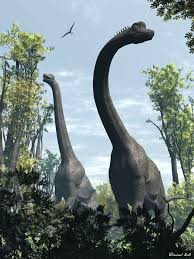
The Behemoth which we will consider in this paper is type of dinosaur called the “Sauropod ”
👉 Sauropoda, or the sauropods, are a clade of saurischian dinosaurs. They had very long necks, long tails, small heads, and four thick, pillar-like legs. They are notable for the enormous sizes attained by some species, and the group includes the largest animals to have ever lived on land.
The taxon ‘Dinosauria‘ was formally named in 1841 by paleontologist Sir Richard Owen, who used it to refer to the “distinct tribe or sub-order of Saurian Reptiles” that were then being recognized in England and around the world. The term is derived from Ancient Greek δεινός (deinos), meaning ‘terrible, potent or fearfully great’, and σαῦρος (sauros), meaning ‘lizard or reptile’.
In Genesis 1:24 “God said, “I command the earth to give life to all kinds of tame animals, wild animals, and reptiles.” And that’s what happened.
👉 In Leviticus 11:30 ” The gecko, the monitor lizard, the wall lizard, the skink and the chameleon.
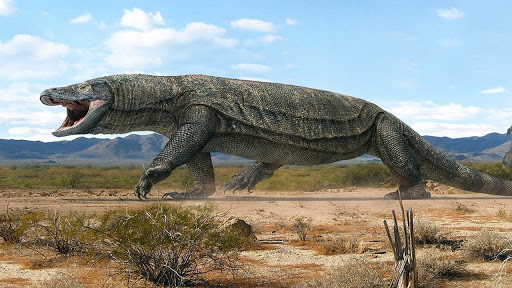
Megalania refers to an extinct giant goanna or monitor lizard, recognised as either Megalania prisca or Varanus priscus. They were part of the megafaunal assemblage that inhabited southern Australia during the Pleistocene. The youngest fossil remains dated to around 50,000 years ago.
 THE SCIENCE OF THE BIBLE