
Have you ever looked up into the night sky and wondered just how many stars there are in space? This question has fascinated scientists as well as philosophers, musicians and dreamers throughout the ages.
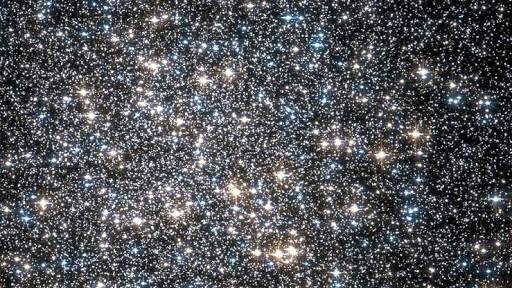
Look into the sky on a clear night, out of the glare of streetlights, and you will see a few thousand individual stars with your naked eyes. With even a modest amateur telescope, millions more will come into view.
So how many stars are there in the Universe? It is easy to ask this question, but difficult for scientists to give a fair answer!
Stars are not scattered randomly through space, they are gathered together into vast groups known as galaxies. The Sun belongs to a galaxy called the Milky Way. Astronomers estimate there are about 100 thousand million stars in the Milky Way alone. Outside that, there are millions upon millions of other galaxies also!
It has been said that counting the stars in the Universe is like trying to count the number of sand grains on a beach on Earth. We might do that by measuring the surface area of the beach, and determining the average depth of the sand layer.
If we count the number of grains in a small representative volume of sand, by multiplication we can estimate the number of grains on the whole beach.
The Bible states that the stars in the sky cannot be counted :
👉 In Jeremiah 33:22 “And as the stars of the sky cannot be counted and the sand on the seashore cannot be measured, so I will multiply the descendants of my servant David and the Levites who minister before me.”
Galaxy observations:
It’s easier to count stars when they are inside galaxies, since that’s where they tend to cluster. To even begin to estimate the number of stars, then you would need to estimate the number of galaxies and come up with some sort of an average.
Some estimates peg the Milky Way’s star mass as having 100 billion “solar masses,” or 100 billion times the mass of the sun. Averaging out the types of stars within our galaxy, this would produce an answer of about 100 billion stars in the galaxy. This is subject to change, however, depending on how many stars are bigger and smaller than our own sun. Also, other estimates say the Milky Way could have 200 billion stars or more.
The number of galaxies is an astonishing number, however, as shown by some imaging experiments performed by the Hubble Space Telescope. Several times over the years, the telescope has pointed a detector at a tiny spot in the sky to count galaxies, performing the work again after the telescope was upgraded by astronauts during the shuttle era.
A 1995 exposure of a small spot in Ursa Major revealed about 3,000 faint galaxies. In 2003-4, using upgraded instruments, scientists looked at a smaller spot in the constellation Fornax and found 10,000 galaxies. An even more detailed investigation in Fornax in 2012, with even better instruments, showed about 5,500 galaxies.
Kornreich used a very rough estimate of 10 trillion galaxies in the universe. Multiplying that by the Milky Way’s estimated 100 billion stars results in a large number indeed:1,000,000,000,000,000,000,000,000 stars, or a “1” with 24 zeros after it (1 septillion in the American numbering system; 1 quadrillion in the European system). Kornreich emphasized that number is likely a gross underestimation, as more detailed looks at the universe will show even more galaxies.
👉 In Job 9:7,9-10 “Which commandeth the sun, and it riseth not; and sealeth up the stars…”Which maketh Arcturus, Orion, and Pleiades, and the chambers of the south.Which doeth great things past finding out; yea, and wonders without number.
 THE SCIENCE OF THE BIBLE