
Most of the stars you see in the night sky with your naked eye are individual stars inside our own galaxy. It takes telescopes to see the stars outside our galaxy or even to see other galaxies. The stars in our galaxy are all orbiting in a nearly circular path around the center of the galaxy. They do this because the immense combined mass of the galaxy, most if it near the center, creates immense gravity that pulls all the stars in our galaxy into circular orbits. In addition, each star in the galaxy has a small random motion relative to the overall galactic rotation. The same concepts apply to stars in other galaxies. Each star orbits its galaxy’s center and has a slight random motion on top of this. Each star does not careen randomly about like a drunkard. Rather, each star travels on a smooth, nearly-straight trajectory as dictated by its own momentum and the local gravitational field. But when comparing the motion of many stars in a galaxy and subtracting out their galactic rotation, you end up with a random distribution. The reason for this is simply the randomness of the materials from which the stars formed, and the tendency of objects to drift under their own inertia in nearly the same path for eons in the near-vacuum of space.
Thousand of years before the scientific discovery is already revealed in Holy Bible that states about the orbits of the stars .
Judges 5:20 NLT ” The stars fought from heaven. The stars in their orbits fought against Sisera.
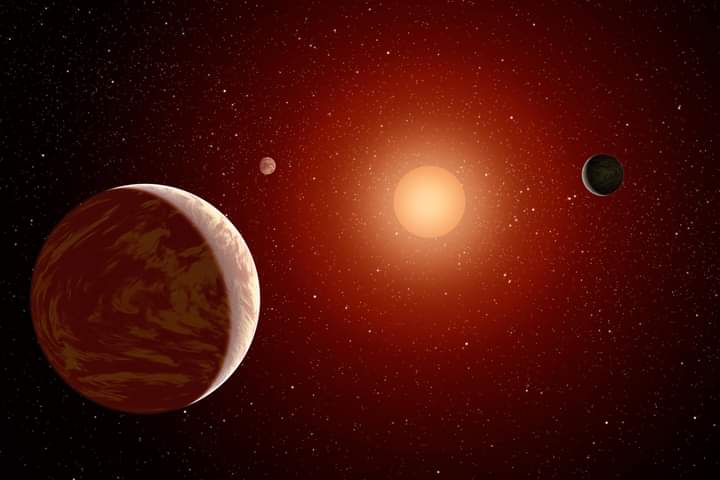
A star system or stellar system is a small number of stars that orbit each other, bound by gravitational attraction. A large group of stars bound by gravitation is generally called a star cluster or galaxy, although, broadly speaking, they are also star systems. Star systems are not to be confused with planetary systems, which include planets and similar bodies (such as comets).
A binary star is a star system consisting of two stars orbiting around their common barycenter. Systems of two or more stars are called multiple star systems.
Habakkuk 3:11 ISV ” The sun and moon stand still in their orbits; at the glint of your arrows they speed along, even at the gleam of your flashing spear.
Earth’s orbit:
While Earth orbits the sun, the planet is simultaneously spinning on an imaginary line called an axis that runs from the North Pole to the South Pole. It takes Earth 23.934 hours to complete a rotation on its axis and 365.26 days to complete an orbit around the sun.
Job 9:6 ISV ” He shakes the earth from its orbit, so that its foundations shudder.
Earth’s axis of rotation is tilted in relation to the ecliptic plane, an imaginary surface through the planet’s orbit around the sun. This means the Northern and Southern hemispheres will sometimes point toward or away from the sun depending on the time of year, and this changes the amount of light the hemispheres receive, resulting in the seasons.
Earth’s orbit is not a perfect circle, but rather an oval-shaped ellipse, similar to the orbits of all the other planets. Our planet is a bit closer to the sun in early January and farther away in July, although this variation has a much smaller effect than the heating and cooling caused by the tilt of Earth’s axis. Earth happens to lie within the so-called “Goldilocks zone” around the sun, where temperatures are just right to maintain liquid water on our planet’s surface.
 THE SCIENCE OF THE BIBLE