
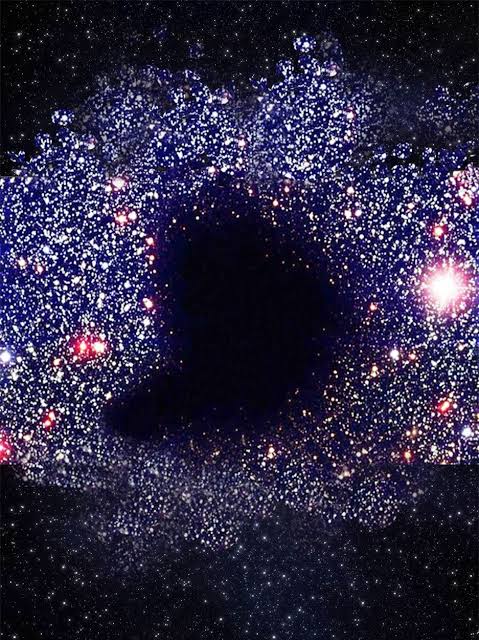
The universe has a huge hole in it that dwarfs anything else of its kind. The discovery caught astronomers by surprise.
The hole is nearly a billion light-years across. It is not a black hole, which is a small sphere of densely packed matter. Rather, this one is mostly devoid of stars, gas and other normal matter, and it’s also strangely empty of the mysterious “dark matter” that permeates the cosmos. Other space voids have been found before, but nothing on this scale.
Astronomers don’t know why the hole is there.Between constellations Perseus and Taurus, astronomers have discovered a spherical void spanning nearly 500 light-years in diameter. The so-called cavity is so large, that it can house over 150,000 variants of our solar system.
The discovery of this mysterious void, which is surrounded by molecular clouds – regions of space containing dense clouds of dust and gas, where new stars are born – could shed new light on the formation of stars.
Dubbed the Per-Tau Shell, researchers at the Harvard-Smithsonian Center for Astrophysics (CfA), think the void could be the result of a giant supernova explosion, some 10 million years ago. The explosion likely triggered star formation by compressing the two molecular clouds—Perseus and Taurus—surrounding the void.
The Bible states…
Job 26:7 ” He spreads out the northern skies over empty space; …”
The Boötes void is enormous, with a radius of 62 megaparsecs. It is an approximately spherical region of space, containing very few galaxies, found in the vicinity of the constellation Boötes, hence its name. Its centre is located at approximately right ascension 14ʰ 50ᵐ and declination 46°.
A heavenly cavern so gigantic that the mind of man cannot comprehend it, and so brilliantly beautiful that words cannot adequately describe it. These revelations were made possible by gigantic lenses, plus long exposures of photographic plates, which in turn can be further magnified..
Astronomers seem to agree that there is a huge opening in Orion which is perhaps more than sixteen trillion miles in diameter. This means that across the entrance of this opening in the North, there could be 30,000 solar systems like ours with a sun in the middle of each — and still there would be room to spare.
One scientist, Mr. Learkin of Mt. Lowe Observatory, describes it this way: “The interior of the cavern is so stupendous that our entire solar system would be lost therein. I have watched it since the days of youth in many telescopes of many powers,” he said, “but I never dreamed that the central region is the mouth of a colossal cave.
The pen of a writer and the brush of an artist would be lifeless and inert in any attempt to describe this interior; for the depth of the Orion nebula appears like torn and twisted objects and river masses of shining glass, irregular pillars, columns of stalactites in glittering splendor and stalagmites from the mighty floor.
The appearance is like that of light shining and glowing behind the clear walls of ivory and pearl, studded with millions of diamonds like shining stars.”
The scientist went on to say that there must be some reason why all this grandeur is lavished on this one spot in the heavens. “The colors are a hue peculiar to the Orion and studded around the opening so that they appear as a pavement of starry sand.
No wonder the astronomers (many of them not religious), say they feel as if they were in some Almighty “Presence” while scanning this part of the heavens and become speechless before this great outburst of grandeur extending for trillions of miles through space.
 THE SCIENCE OF THE BIBLE