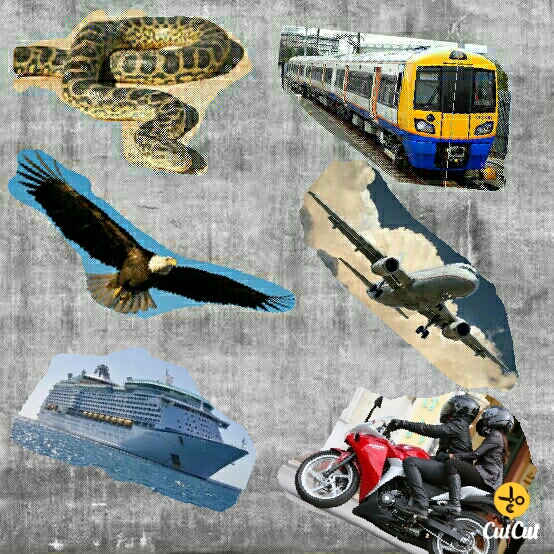
👉 In Proverbs 30:18-19 “There be three things which are too wonderful for me, yea, four which I know not: The way of an eagle in the air; the way of a serpent upon a rock; the way of a ship in the midst of the sea; and the way of a man with a maid.
👉 The way of an eagle in the sky was the invention of planes that fly in sky :
An airway or air route is a defined corridor that connects one specified location to another at a specified altitude, along which an aircraft that meets the requirements of the airway may be flown.
👉 The way of a serpent upon the rocks was the invention of the Engine train that his railroad was the mountains rocks and tunnel like a snake .
Rail transport is a means of transferring passengers and goods on wheeled vehicles running on rails, which is also known as tracks. It is also commonly referred to as train transport.
👉 The way of the ship in the midst of the sea :
A sea lane, sea road or shipping lane is a regularly used route for vessels on oceans and large lakes. In the Age of Sail they were not only determined by the distribution of land masses but also the prevailing winds, whose discovery was crucial for the success of long voyages. Sea lanes are very important for trade by sea.
👉 The way of a man with a maid was the invention of motorcycle that travel in land .
In Daniel 1:4 KJV “Children in whom was no blemish, but well favoured, and skilful in all wisdom, and cunning in knowledge, and understanding SCIENCE, and such as had ability in them to stand in the king’s palace, and whom they might teach the learning and the tongue of the Chaldeans.
Broadcasting is the distribution of audio or video content to a dispersed audience via any electronic mass communications medium, but typically one using the electromagnetic spectrum (radio waves), in a one-to-many mode Broadcasting began with AM radio, which came into popular use around 1920 with the spread of vacuum tube radio transmitters and receivers.
Over the air broadcasting is usually associated with radio and television, though more recently, both radio and television transmissions have begun to be distributed by cable (cable television). The receiving parties may include the general public or a relatively small subset; the point is that anyone with the appropriate receiving technology and equipment (e.g., a radio or television set) can receive the signal. The field of broadcasting includes both government-managed services such as public radio, community radio and public television, and private commercial radio and commercial television.
Our Lord Jesus Christ prophesy about this technology spoken in the ear on closets shall be proclaimed upon the housetops through TV and radio Antina.
Luke 12:3 ” Therefore whatsoeverye have spoken in darkness shall be heard in the light; and that which ye have spoken in the ear in closets shall be proclaimed upon the housetops.
Through social Media you can broadcast globally your voice will be heard throught the whole world because of INTERNET technology.
The internet, something mainly limited to advanced nations only two to three decades ago, is now found in even some of the most remote corners of our planet. It’s even connected to the International Space Station! It’s truly gone global. And as it’s gone global, it’s played an important role in global mass communication in numerous ways, like personal communication. For example, if Mary is going on a business trip to France, she can communicate with her friends via video chat, a smartphone app, or email all thanks to the internet.
Romans 10:18 “But I say, Have they not heard? Yes verily, their sound went into all the earth, and their words unto the ends of the world.
In the Book of Job 38:22 “Have you visited the storehouses of the snow or seen the storehouses of hail?
The storehouses of snow is the Continent of Antarctica.
Antarctica is Earth’s southernmost and least-populated continent. Situated almost entirely south of the Antarctic Circle and surrounded by the Southern Ocean, it contains the geographic South Pole. Antarctica is the fifth-largest continent, being nearly twice the size of Australia and larger than Europe, and has an area of 14,200,000 km2 (5,500,000 sq mi). Most of Antarctica is covered by ice, with an average thickness of 1.9 km (1.2 mi).
Antarctica is the coldest, windiest and driest continent. It contains 90 percent of all of the ice on Earth in an area just under 1.5 times the size of the United States. But the southernmost continent is much more than a big block of ice.
Wormhole, solution of the field equations in German-born physicist Albert Einstein’s theory of general relativity that resembles a tunnel between two black holes or other points in space-time. Such a tunnel would provide a shortcut between its end points.
The Bible states…
Matthew 24:31 “…from one end of the heavens to the other.“
The wormhole theory postulates that a theoretical passage through space-time could create shortcuts for long journeys across the universe. Wormholes are predicted by the theory of general relativity. But be wary: wormholes bring with them the dangers of sudden collapse, high radiation and dangerous contact with exotic matter.
When was the wormhole theory created?
Through the wormhole How wormholes work? The wormhole theory postulates that a theoretical passage through space-time could create shortcuts for long journeys across the universe. Wormholes are predicted by the theory of general relativity. But be wary: wormholes bring with them the dangers of sudden collapse, high radiation and dangerous contact with exotic matter.
WORMHOLE THEORY
Wormholes were first theorized in 1916, though that wasn’t what they were called at the time. While reviewing another physicist’s solution to the equations in Albert Einstein’s theory of general relativity, Austrian physicist Ludwig Flamm realized another solution was possible. He described a “white hole,” a theoretical time reversal of a black hole. Entrances to both black and white holes could be connected by a space-time conduit.
In 1935, Einstein and physicist Nathan Rosen used the theory of general relativity to elaborate on the idea, proposing the existence of “bridges” through space-time. These bridges connect two different points in space-time, theoretically creating a shortcut that could reduce travel time and distance. The shortcuts came to be called Einstein-Rosen bridges, or wormholes.
Psalms 19:1-6 ” The heavens declare the glory of God; and the firmament sheweth his handywork. Day unto day uttereth speech, and night unto night sheweth knowledge. There is no speech nor language, where their voice is not heard. Their line is gone out through all the earth, and their words to the end of the world. In them hath he set a tabernacle for the sun, Which is as a bridegroom coming out of his chamber, and rejoiceth as a strong man to run a race.His going forth is from the end of the heaven, and his circuit unto the ends of it: and there is nothing hid from the heat thereof.”
3D illustration tunnel or wormhole, tunnel that can connect one universe with another. Abstract speed tunnel warp in space, wormhole or black hole, scene of overcoming the temporary space in cosmos.
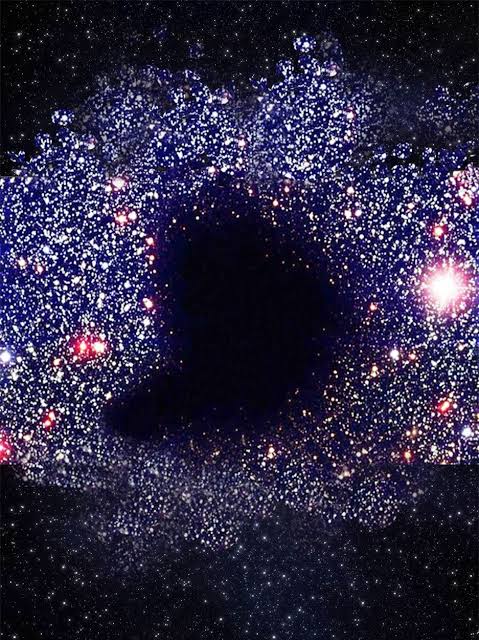
The universe has a huge hole in it that dwarfs anything else of its kind. The discovery caught astronomers by surprise.
The hole is nearly a billion light-years across. It is not a black hole, which is a small sphere of densely packed matter. Rather, this one is mostly devoid of stars, gas and other normal matter, and it’s also strangely empty of the mysterious “dark matter” that permeates the cosmos. Other space voids have been found before, but nothing on this scale.
Astronomers don’t know why the hole is there.Between constellations Perseus and Taurus, astronomers have discovered a spherical void spanning nearly 500 light-years in diameter. The so-called cavity is so large, that it can house over 150,000 variants of our solar system.
The discovery of this mysterious void, which is surrounded by molecular clouds – regions of space containing dense clouds of dust and gas, where new stars are born – could shed new light on the formation of stars.
Dubbed the Per-Tau Shell, researchers at the Harvard-Smithsonian Center for Astrophysics (CfA), think the void could be the result of a giant supernova explosion, some 10 million years ago. The explosion likely triggered star formation by compressing the two molecular clouds—Perseus and Taurus—surrounding the void.
The Bible states…
Job 26:7 ” He spreads out the northern skies over empty space; …”
The Boötes void is enormous, with a radius of 62 megaparsecs. It is an approximately spherical region of space, containing very few galaxies, found in the vicinity of the constellation Boötes, hence its name. Its centre is located at approximately right ascension 14ʰ 50ᵐ and declination 46°.
A heavenly cavern so gigantic that the mind of man cannot comprehend it, and so brilliantly beautiful that words cannot adequately describe it. These revelations were made possible by gigantic lenses, plus long exposures of photographic plates, which in turn can be further magnified..
Astronomers seem to agree that there is a huge opening in Orion which is perhaps more than sixteen trillion miles in diameter. This means that across the entrance of this opening in the North, there could be 30,000 solar systems like ours with a sun in the middle of each — and still there would be room to spare.
One scientist, Mr. Learkin of Mt. Lowe Observatory, describes it this way: “The interior of the cavern is so stupendous that our entire solar system would be lost therein. I have watched it since the days of youth in many telescopes of many powers,” he said, “but I never dreamed that the central region is the mouth of a colossal cave.
The pen of a writer and the brush of an artist would be lifeless and inert in any attempt to describe this interior; for the depth of the Orion nebula appears like torn and twisted objects and river masses of shining glass, irregular pillars, columns of stalactites in glittering splendor and stalagmites from the mighty floor.
The appearance is like that of light shining and glowing behind the clear walls of ivory and pearl, studded with millions of diamonds like shining stars.”
The scientist went on to say that there must be some reason why all this grandeur is lavished on this one spot in the heavens. “The colors are a hue peculiar to the Orion and studded around the opening so that they appear as a pavement of starry sand.
No wonder the astronomers (many of them not religious), say they feel as if they were in some Almighty “Presence” while scanning this part of the heavens and become speechless before this great outburst of grandeur extending for trillions of miles through space.
The universe is similar to a huge human brain, scientists have found.
A new study investigated the differences and similarities between two of the most complex systems in existence, though at entirely difference scales: the cosmos and its galaxies and the brain and its neuronal cells.
They found that while the scale is clearly different, the structure is remarkably similar. In some cases, the two systems seemed more similar to each other than they did to the parts that make them up.
What is Thought?
👉 an idea, plan, opinion, picture, etc., that is formed in your mind.
The identity theory of mind holds that states and processes of the mind are identical to states and processes of the brain.
The Bible states in Isaiah 55:8-9
That the LORD say :
" For my thoughts are not your thoughts, neither are your ways my ways, saith the LORD.“For as the heavens are higher than the earth, So are My ways higher than your ways, And My thoughts than your thoughts."
If God thoughts are higher than our human thoughts and for as the heavens are higher than the earth.thought is formed in the mind, and the mind processes inside our brain, Our Universe is similar to a huge human brain.
The early results from Gravity Probe B, one of Nasa’s most complicated satellites, confirmed yesterday ‘to a precision of better than 1 per cent’ the assertion Einstein made 90 years ago – that an object such as the Earth does indeed distort the fabric of space and time.
But this – what is referred to as the ‘geodetic’ effect – is only half of the theory. The other, ‘frame-dragging’, stated that as the world spins it drags the fabric of the universe behind it. Francis Everitt, the Stanford University professor who has devoted his life to investigating Einstein’s theory of relativity, told scientists at the American Physical Society it would be another eight months before he could measure the ‘frame-dragging’ effect precisely.
Scientist observe the space is like a fabric of space and time :
What is Fabric?
cloth or other material produced by weaving or knitting fibers.
The Bible states in Hebrews 1:12 CSB: the heavens will roll like a cloak, and they will be changed like clothings
“Clothings ” cloak ” is made of Fabric, our space is like a fabric of space and time .
How the Bible knows this!
If the Bible is not word of God.
"you will roll them up like a cloak,and they will be changed like clothing.But you are the same,and your years will never end."
Revelation 6:14 ” Then the sky was rolled up like a scroll, …”
The biggest lesson from Einstein’s general theory of relativity is that space itself isn’t a flat, unchanging, absolute entity. Rather it’s woven together, along with time, into a single fabric: spacetime. This fabric is continuous, smooth, and gets curved and deformed by the presence of matter and energy.
The wormhole theory postulates that a theoretical passage through space-time could create shortcuts for long journeys across the universe. Wormholes are predicted by the theory of general relativity. But be wary: wormholes bring with them the dangers of sudden collapse, high radiation and dangerous contact with exotic matter.
Psalms 19:6 ” Its rising is from one end of the heavens, And its circuit to the other end of them; And there is nothing hidden from its heat.”
A company is manufacturing charcoal from human poo and sawdust collected around Nakuru, Kenya. Locals have embraced its use and are using the briquettes for cooking and other purposes. The project aims to help protect the environment and improve sanitation especially in poor parts of the town.
In the Book of Ezekiel 4:12 states:
“Prepare and eat this food as you would barley cakes. While all the people are watching, bake it over a fire using dried human dung as fuel and then eat the bread.”
The charcoal is made through a process called carbonisation. First, the waste is collected and left to dry in a greenhouse for two weeks. It is then broken down and mixed with sawdust before being placed in a kiln. The carbonisation process ensures that there is no smell left over from the human waste.
The company wants to expand their venture to other towns in Kenya that have poor sanitation.
The famous “pillars of creation” – clouds of dust and gas imaged by the Hubble Space Telescope, are no more – a supernova blast wave has blown them apart. But their ghostly image will linger for another thousand years because of the time it takes for light to travel from them to Earth.
The pillars have been astronomical icons since Hubble imaged them in 1995 (scroll down for Hubble image). They are part of a larger star-forming region called the Eagle Nebula, which lies 7000 light years away. That means we are seeing the pillars as they were 7000 years ago, when the light first left them.
Now, an infrared image from the Spitzer Space Telescope has revealed a previously unseen supernova blast wave that was advancing towards the pillars at that time, threatening to ultimately sweep them away.
In the Book of Job 26:11 states
" The pillars of heaven tremble, And are astonished at His rebuke."
The Apocalyptic prophecy about the great quake that threatening the pillars .
In the Book of Hebrew 12:26 states.
" At that time his voice shook the earth, but now he has promised, “Yet once more I will shake not only the earth but also the heavens.”
Nicolas Flagey of the Institut d’Astrophysique Spatiale in Orsay, France, led a team that obtained the image. It shows a cloud of hot dust thought to have been heated by a supernova blast that likely occurred between 1000 and 2000 years earlier.
Based on the cloud’s position, the blast wave looked set to hit the pillars in 1000 years. Taking into account the 7000-year time lag for their light to reach the Earth, that means the pillars were actually destroyed 6000 years ago, Flagey says.
We will not see their obliteration from Earth for another 1000 years, however. And when we do, they will be in tatters – Flagey says only a few patches of the pillars are dense enough to survive the blast. “All the other parts will crumble when the shock wave arrives,” he says.
Now, his team is searching through historical records to see if ancient astronomers spotted the supernova responsible for the pillars’ destruction. It should have become visible on Earth 1000 to 2000 years ago, but while a few candidate events have been found in the right time frame, so far none has been confirmed as the culprit.
Stellar wind:
But Stephen Reynolds of North Carolina State University in Raleigh, US, is not convinced the hot dust cloud is the result of a supernova explosion. The expanding gas, or remnant, from the event should emit much stronger radio waves and X-rays than have been observed, he says.
“I believe that a supernova remnant less than 2000 years old at a distance of less than 6000 light years would have to have quite unusual properties to have avoided detection to this point,” he told New Scientist.
Instead, he suggests that hot, high-speed winds from massive stars in the region could have heated up the dust grains in the cloud. If so, the presence of this hot gas would still erode the pillars of creation over time, he says.
The results were presented on Tuesday at a meeting of the American Astronomical Society in Seattle, Washington, US.
Stellar evolution is a circle of life — dying stars spew their contents into the galaxy, paving the way for the next generation.
The Bible states…
In Hebrew 1:10-12 The heavens are the work of youryour hands, you willroll them up like a robe likr a garment they will be CHANGED?
“In the beginning, Lord, you laid the foundations of the earth, and the heavens are the work of your hands.They will perish, but you remain; they will all wear out like a garment. You will roll them up like a robe; like a garment they will be changed. But you remain the same, and your years will never end.
Stars do not live forever, just like people. Stars are born, live their lives, changing or evolving as they age, and eventually they die.
Hubble Space Telescope’s high resolution and wide-wavelength sensitivity gave astronomers key new insights into the lives of stars from birth to death. Hubble probed stellar incubators the vast molecular clouds. The telescope surprisingly uncovered the first evidence that planet formation accompanies star birth. The fireworks that accompany star death, from exotic-looking planetary nebula to titanic stellar explosions, unveiled new mysteries to Hubble.
The immense nebula contains at least a dozen brilliant stars that are roughly estimated to be at least 50 to 100 times the mass of our Sun. The most unique inhabitant is the star Eta Carinae, which is in the final stages of its brief and eruptive lifespan.
Some stars in stellar nurseries are born inside dense clouds of cold gas. Hubble has observed several of these natal cocoons. The most famous is the trio of giant gas columns in the Eagle Nebula. Dubbed the “Pillars of Creation,” these stellar nurseries are bathed in the scorching ultraviolet light from a cluster of young, massive stars. Streamers of gas can be seen bleeding off pillars as the intense radiation heats and evaporates it into space. Denser regions of the pillars are shielding material beneath them from the powerful radiation.
A later, infrared view of the pillars transforms them into eerie, wispy silhouettes seen against a background of myriad stars. Infrared light penetrates much of the gas and dust, except for the densest regions of the pillars. Newborn stars can be seen hidden away inside the giant columns.
" Can you, like Him, spread out the skies to reflect the heat like a mirror of bronze"
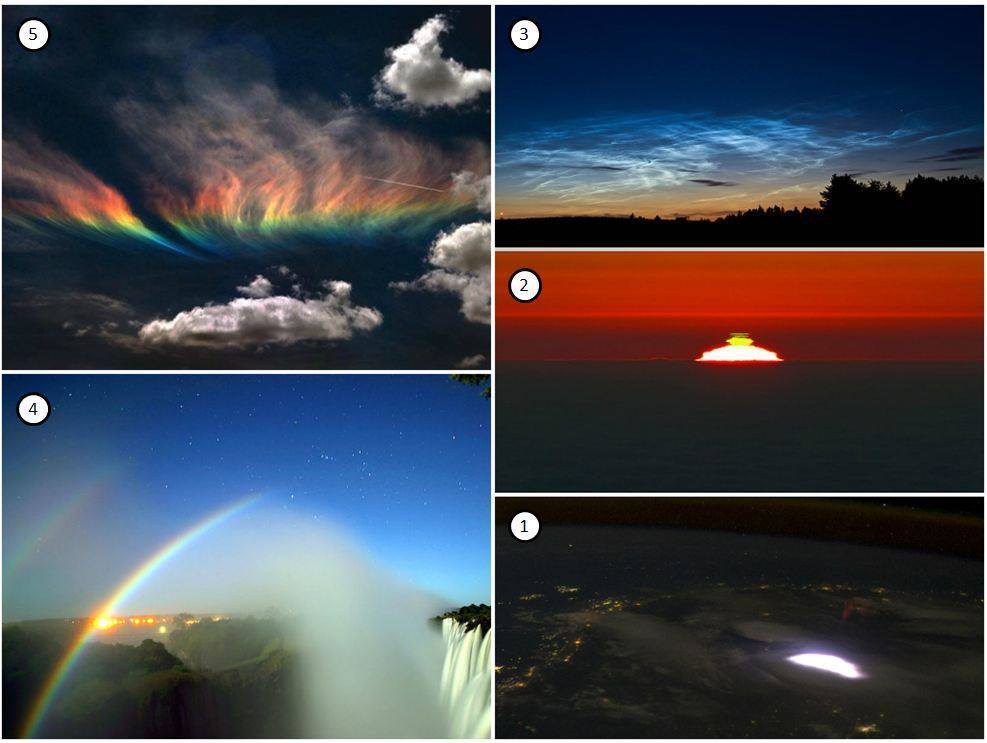
Atmospheric optical phenomena are visual events that take place in Earth’s atmosphere as a consequence of light reflection, refraction, and diffraction by solid particles, liquids droplets, and other materials present in the atmosphere. Such phenomena include a wide variety of events ranging from the blue color of the sky itself to mirages and rainbows to sundogs and solar pillars.
The distinctive coloration results from Earth’s atmosphere acting like a prism.
Reflection and refraction The fact that colors appear in the atmosphere is a consequence of the way that white light is broken up into its component parts—red, orange, yellow, green, blue, indigo, and violet (the spectrum)—during its interaction with materials in the atmosphere. That interaction takes one of three general forms: reflection, refraction, and diffraction.
Reflection occurs when light rays strike a smooth surface and return at an angle equal to that of the incoming rays. Reflection can explain the origin of color in some cases, because certain portions of white light are more easily absorbed or reflected than are others. For example, an object that appears to have a green color does so because that object absorbs all wavelengths of white light except that of green, which is reflected.
One form of reflection—internal reflection—is often involved in the explanation of optical phenomena. During internal reflection, light enters one surface
of a transparent material (such as a water droplet), is reflected off the inside surface of the material, and is then reflected a second time out of the material. The color of a rainbow can partially be explained in terms of internal reflection.
Refraction is the bending of light as it passes at an angle from one transparent material into a second transparent material. The process of refraction accounts for the fact that objects under water appear to have a different size and location than they have in air. Light waves passing through water and then through air are bent, causing the eye to create a visual image of the object.
Displacement phenomena Perhaps the most common example of an atmospheric effect created by refraction is the displacement of astronomical bodies. When the sun is directly overhead, the light rays it emits pass straight through Earth’s atmosphere. No refraction occurs, and no change in the sun’s apparent position takes place.
As the sun approaches the horizon, that situation changes. Light from the sun enters Earth’s atmosphere at an angle and is refracted. The eye sees the path of the light as it is bent and assumes that it has come from a position in the sky somewhat higher than it really is. That is, the sun’s apparent location is displaced by some angle from its true location. The same situation is true for any astronomical object. The closer a star is to the horizon, for example, the more its apparent position is displaced from its true position.
Green flash One of the most dramatic examples of sunlight refraction is the green flash. That term refers to the fact that in the moment following sunset or sunrise,
a flash of green light lasting no more than a second can sometimes be seen on the horizon on the upper part of the sun. The green light is the very last remnant of sunlight refracted by Earth’s atmosphere, still observable after all red, orange, and yellow rays have disappeared. The green light remains at this moment because the light rays of shorter wavelength—blue and violet—are scattered by the atmosphere. The green flash is rarely seen.
Scattered light Light that bounces off small objects is not reflected uniformly, but is scattered in all directions. The process of scattering is responsible for the fact that humans observe the sky as blue. When white light from the sun collides with molecules of oxygen and nitrogen, it is scattered selectively. That is, light with shorter wavelengths—blue, green, indigo, and violet—is scattered more strongly than is light with longer wavelengths—red, orange, and yellow. No matter where a person stands on Earth’s surface, she or he is more likely to see the bluish light scattered by air molecules than the light of other hues.
Twinkling Stars twinkle; planets do not. This general, though not inviolable, rule can be explained in terms of refraction. Stars are so far away that their light reaches Earth’s atmosphere as a single point of light. As that very narrow beam of light passes through Earth’s atmosphere, it is refracted and scattered by molecules and larger particles of matter. Sometimes the light travels straight toward an observer and sometimes its path is deflected. To the observer, the star’s light appears to alternate many times per second, which produces twinkling.
Planets usually do not twinkle because they are closer to Earth. The light that reaches Earth from them consists of wider beams rather than narrow rays. The refraction or scattering of only one or two light rays out of the whole beam does not make the light seem to disappear. At any one moment, enough light rays reach Earth’s surface from a planet to give a sense of one continuous beam of light.
Mirages One of the most familiar optical phenomena produced by refraction is a mirage. One type of mirage— the inferior mirage—is caused when a layer of air close to the ground is heated more strongly than is the air immediately above it. When that happens, light rays pass through two transparent media—the hot, less dense air and the cooler, more dense air—and are refracted. As a result of the refraction, the blue sky appears to be present on Earth’s surface; it may look like a body of water and objects such as trees appear to be reflected in that water.
A second type of mirage—the superior mirage— forms when a layer of air next to the ground is much cooler than the air above it. In this situation, light rays from an object are refracted in such a way that an object appears to be suspended in air above its true position. This phenomenon is sometimes referred to as looming.
Rainbows The most remarkable phenomenon in the atmosphere may be the rainbow. To understand how a rainbow is created, imagine a single beam of white light entering a spherical droplet of water. As the light passes from air into water, it is refracted (bent). However, each color present in the white light is refracted by a different amount—the blues and violets more than the reds and yellows. The light is said to be dispersed, or separated, according to color. After the dispersed rays pass into the water droplet, they reflect off the rear inner surface of the droplet and exit into the air once more. As the light rays pass out of the water into the air, they are refracted a second time. As a result of this second refraction, the separation of blues and violets from reds and yellows is made more distinct.
An observer on Earth’s surface can see the net result of this sequence of events repeated over and over again by billions of individual water droplets. The rainbow that is produced consists simply of the white light of the sun separated into its component parts by each separate water droplet.
Haloes, sundogs, and sun pillars The passage of sunlight through cirrus clouds can produce any one of the optical phenomena known as haloes, sundogs, or sun pillars. One explanation for phenomena of this kind is that cirrus clouds consist of tiny ice crystals that refract light through very specific angles, namely 22° and 46°. When sunlight shines through a cirrus cloud, each tiny ice crystal acts like a glass prism, refracting light at an angle of 22° (more commonly) or 46° (less commonly).
A halo is one example of this phenomenon. Sunlight shining through a cirrus cloud is refracted in such a way that a circle of light—the halo—forms around the sun. The halo may occur at 22° or 46°.
Sundogs are formed by a similar process and occur during sunrise or sunset. When relatively large (about 30 microns) crystals of ice orient themselves horizontally in a cirrus cloud, the refraction pattern they form is not a circle (a halo), but a reflected image of the sun. This reflected image is located at a distance of 22° from the actual sun, often at or just above the horizon. Sundogs are also known as mock suns or parhelia.
Sun pillars are, as their name suggests, narrow columns of light that seem to grow out of the top or (less commonly) from the bottom of the sun. This phenomena is a result not of refraction, but of reflection. Sunlight reflects off the bottom of flat ice crystals as they settle slowly toward Earth’s surface. The exact shape and orientation of the sun pillar depends on the position of the sun above the horizon and the exact orientation of the ice crystals to the ground.
Coronas and glories In addition to reflection and refraction, the path of a light ray can be altered by yet a third mechanism, diffraction. Diffraction occurs when a light ray passes close to some object. For comparison, you can think of the way in which water waves are bent as they travel around a rock. Diffraction may also result in the separation of white light into its colored components.
When light rays from the Moon pass through a thin cloud, they may be diffracted. Interference of the various components of white light that generates the colors makes up the corona. The pattern formed by the diffraction rays is a ring around the Moon. The ring may be fairly sharp and crisp, or it can be diffuse and hazy. The ring is known as a corona. Coronas may also form around the sun, although because the sun is much brighter, they are more difficult to observe.
A glory is similar to a corona but is most commonly observed during an airplane ride. As sunlight passes over the airplane, it may fall on water droplets in a cloud below. The light that is diffracted then forms a series of colored rings—the glory—around the airplane’s shadow.






 THE SCIENCE OF THE BIBLE